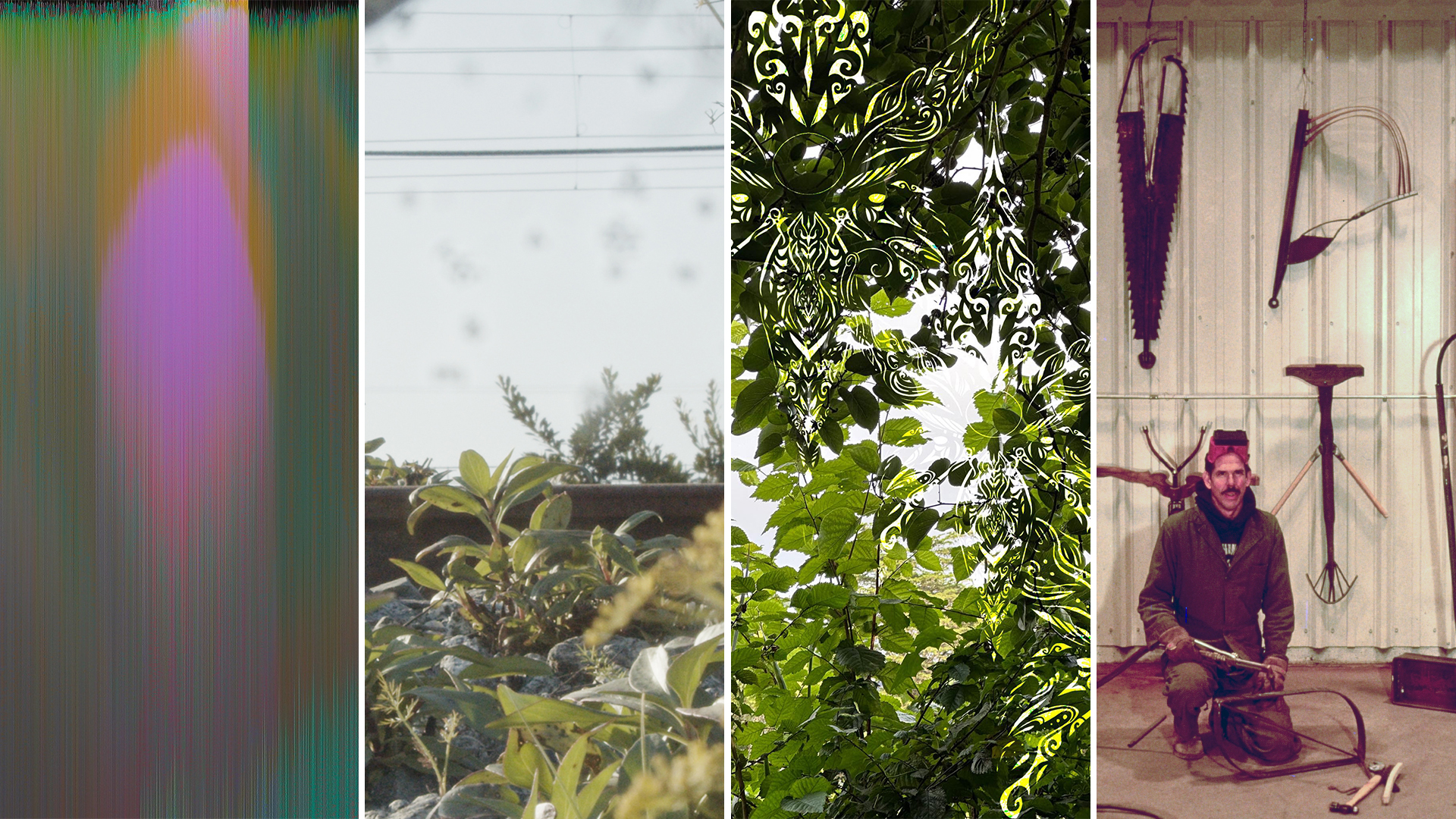
The Artist in Residence Program (AIR) at Recology San Francisco is thrilled to announce exhibition dates for current artists-in-residence Miguel Novelo, Trina Michelle Robinson, and California College of the Arts undergraduate, Haley Mae Caranto, as well as a special retrospective for former AIR Jim Growden to culminate the celebration of our 35th anniversary.
We’re excited to participate in San Francisco Art Week, an annual celebration of the Bay Area’s vibrant arts community, and will be offering extended open hours during these exhibitions.
Friday, January 16, 2026 from 5 – 8 PM
Saturday, January 17, 2026 from 12 – 3 PM
Tuesday, January 20, 2026 from 3 – 7:30 PM with artist talk by Haley Mae Caranto at 6 PM (401 Tunnel), Jim Growden at 6:15 PM (401 Tunnel), Miguel Novelo at 6:30 PM (503 Tunnel), and Trina Michelle Robinson at 7 PM (503 Tunnel).
Wednesday, January 21, 2026 from 12 – 3 PM
Thursday, January 22, 2026 from 1 – 3 PM
Friday, January 23, 2026 from 12 – 3 PM
Admission is free and open to the public, no reservation required. All ages are welcome, and the site is wheelchair accessible.
Location
Recology Art Studios
503 and 401 Tunnel Avenue, San Francisco
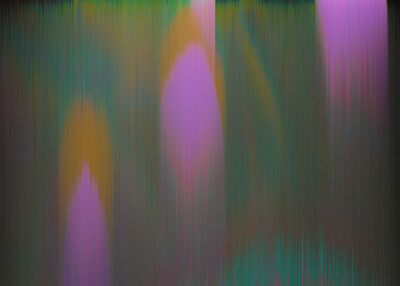 Miguel Novelo
Máquina Fantasma
Written by Weston Teruya
Miguel Novelo’s Máquina Fantasma situates contemporary computing and new media equipment in the longer arc of tools and technologies that human societies have used to perceive and intervene in the world around us. By taking this long view, grounded in an indigenous perspective, he demystifies the spectre of innovation, the chase of profits, and planned obsolescence and its requisite wake of discards.
By layering disparate technologies in the installation, like a digital screen and an automobile tire, Novelo animistically opens portals into the inner lives of our tools–giving a sense of their possible past histories and purpose. The screen displays the wheel–an ancient technology–as it rolls away and moves about. In other sculptures, Novelo cracks open computer casings and motor blocks, laying bare the inner mechanisms of tools typically hidden beneath polished surfaces. Computer case panels are utilized to build a larger structure of surfaces on surfaces; only obscuring other covers. Fans and heat sinks are displayed, recognizing their value to the smooth operation of our tools and emphasizing the resource costs of their workings.
In other pieces, Novelo utilizes disposed digital cameras to capture new images. While most have been tossed aside because of glitches and imperfections in their sensors–what might be labeled as breakage and failure–he sees this as a useful tool to make images differently. The resultant ghostly smears of color make unseen things visible; perceiving things that are outside our current realms of knowing. The display screens in the installation also feature pixelization and cracks, elements that constantly remind us of the process of looking and the workings of the tool, not just an open window to peer through.
Novelo insists that new tools not be seen as separate from nature; something that can be disposable or elevated. Instead, his exhibition asks us to consider the materiality of disposed tech as it lives on the earth with us; the resource costs in how we operate these systems; and how we apply tools to community wellbeing and ways of knowing.
Miguel Novelo is an interdisciplinary artist, educator, and researcher who focuses on emerging media and community organizing—currently working on algorithmic movies, technoshamanic installations, thermodynamic hypnotism, and friendly computer viruses. He has exhibited at the de Young Museum, Stanford Institute for Human-Centered Artificial Intelligence (HAI), the Museo Universitario Arte Contemporáneo (MUAC) in Mexico City, and Grey Area Festival. He has an upcoming exhibition in Spring 2026 with ICA San José. He is a lecturer with Stanford’s Art and Art History Department and San Jose State University.
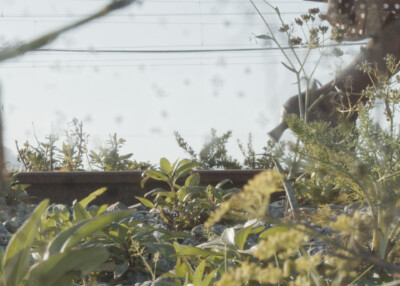 Trina Michelle Robinson
Grounded: A Series
Written by Weston Teruya
Through immersive sound, video, and installations of growing plants, Trina Michelle Robinson’s Grounded: A Series creates a contemplative space to consider the things we gather around us across time and how they speak to our histories and relations. Sonic recordings of unseen objects as they are activated, bounced, and moved in the world fill the gallery space. Robinson interweaves these clips with found recordings. The audio track has a physicality, pulsing through the space and entering our bodies. By deemphasizing the visual presence of the objects she sourced from the Public Reuse and Recycling Area in favor of documenting their sensory or emotive traces, our things become less property to be desired, consumed, or thrown out, than pieces of the world that live alongside us and shape our stories together.
In a series of video and photo works, Robinson also intervenes in archival art prints she encountered in the pile, each depicting Black figures. The found images speak to elements of Southern American history, migration, labor, and the role of Black performers on stage. Her responses to these images include documentation of a storytelling performance she did at the Lincoln Center for the Performing Arts in New York City for The Moth and a brief video performance on a train line. As historic prints, the found images were bought and circulated, shaping community stories. Robinson’s dialogical response makes space for considering new senses of time and relationality, breathing into the archive, finding space for embodied presence in representations that might otherwise read as flat.
Similarly, Robinson’s installation of discarded plants that she recovered and cultivated emphasizes a liberatory desire to her project: her energy is invested in making space for an expansive sense of continued being in the world, alongside people, histories, and our environment. We and our histories, tumultuous and incomplete, are also part of nature, and she invites us to reflect on this within her installation.
Trina Michelle Robinson has exhibited at the BlackStar Film Festival in Philadelphia, the San Francisco Arts Commission Main Gallery, ICA San José, Minnesota Street Project, New York’s Wassaic Project, Bay Area Now 9 at Yerba Buena Center for the Arts, and For-Site; and has had a solo exhibition at the Museum of the African Diaspora. As a storyteller, she has performed on The Moth Mainstage at Lincoln Center for Performing Arts in New York City and toured with them to stages in San Francisco, CA; Portland, OR; Omaha, NE; and Westport, CT; and was featured on the NPR Moth Radio Hour.
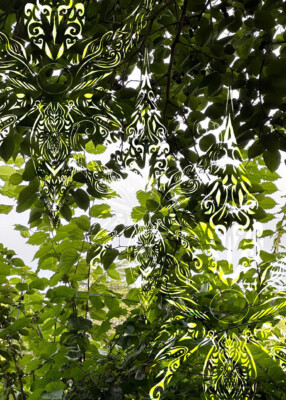 Haley Mae Caranto
Lithophyte
Written by Weston Teruya
Haley Mae Caranto’s intricate, intuitive drawings are an expressive visual diary documenting daily feelings and reflections. Over the years, this record became a way of holding and expressing her vulnerability: navigating identity, mental health, invisible disabilities, and past traumas. Over time, she began layering these images over other contrasting materials, including copies of photos and medical scans, emphasizing depths beneath lines and patterns on a surface.
In Lithophyte, Caranto expands on her drawing practice, etching, cutting, and transforming found materials to continue her exploration of interiority. The resulting installation includes laser-etched ceramic tiles, disparate surfaces covered with her linework, like a network of roots taking hold. Like a radicle burrowing deep, the evocation of roots serves as a reminder of the dynamics beneath surfaces, like the complexities of identity and people’s unseen lives. Even seemingly solid building materials and objects may have unseen complexities outside of the public eye.
Haley Mae Caranto is a multicultural mixed media artist whose work explores the intersections of neurodiversity, cultural fusion, and environmental consciousness. Born with learning disabilities, Caranto embraces the discomfort of societal “norms” and channels it into her artistic practice. Her work serves as a bridge between cultures, ideas, and ways of thinking, ultimately fostering a more inclusive and creative approach to understanding our place in the world. She is currently enrolled at California College of the Arts.
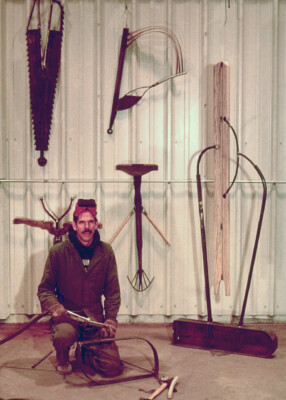 Jim Growden: A Legacy
We are honored to present a retrospective celebrating the enduring influence of community through the works of Jim Growden, the program’s second artist in residence (1991) and longtime Recology employee.
Growden began his career as a figurative sculptor working primarily in bronze and later expanded his practice using found materials. During his Recology residency, he created a series of steel and wood sculptures that will be shown in the Environmental Learning Center Gallery. These works helped to establish a central theme of the AIR program: that art from recycled materials can elevate the transformative potential of creative reuse.
In 1971, Growden moved to a studio on the San Francisco waterfront, a change that profoundly influenced the evolution of his work. Surrounded by the tools and materials of the maritime industry, Growden drew inspiration from their rugged forms and textures. Over time, his approach shifted from literal representation to more abstract interpretations. He began working with wood and welded metal, occasionally incorporating canvas, rope, rubber, and cement, transforming materials into entirely new creations through an intuitive dialogue with the objects, allowing each piece to emerge organically.
After moving to Visitacion Valley in 1993, Growden became involved with the Visitacion Valley Greenway Project. Together with his wife, Fran Martin, and with Recology’s support, he served as the primary designer of the Visitation Valley Greenway’s award-winning gates. He created eight of the twelve signature gates, featuring cut-steel images of native animals and plants seen in the native plant garden and along Leland Avenue.
Following his residency at Recology, Jim transitioned into a different role working for many years in the Household Hazardous Waste Department. After retiring, his passion for art and sustainability brought him back to the AIR Program, where he played a vital role until 2020, inspiring countless artists and community members.
This exhibition underscores the importance of uplifting local artists whose creativity has shaped their neighborhoods and fostered a sense of environmental stewardship, community engagement, and neighborly connection.
Growden received a BA in Art Education from Western Michigan University and moved to San Francisco in 1969 to attend the San Francisco Art Institute where he received an MFA in 1972.